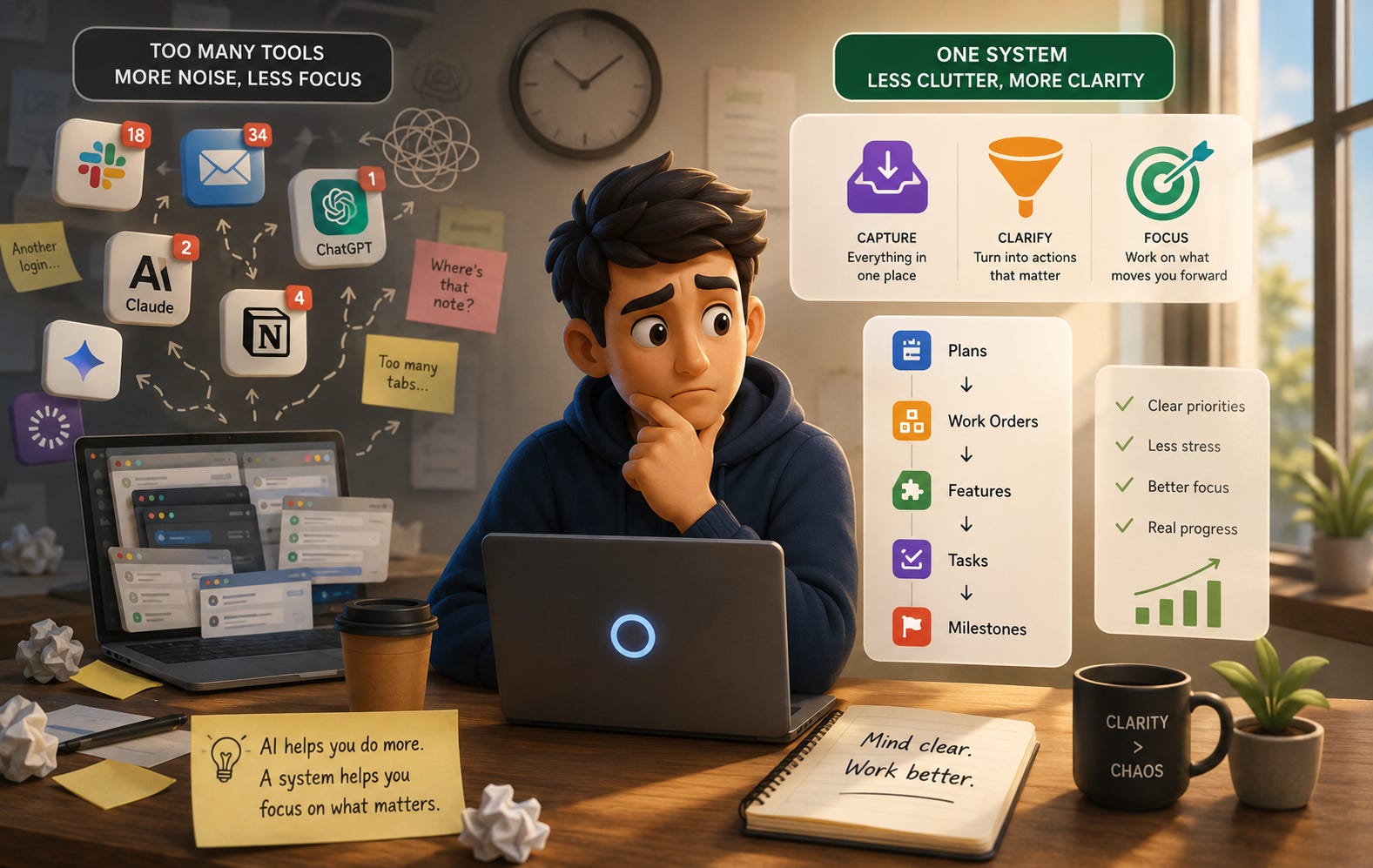
Tell me, Does it sound like your typical Monday morning?
You open your laptop and find
18 unread Slack messages,
34 new emails
A client meeting starting in 20 minutes
ChatGPT is open in one tab,
Claude in another tab
Perplexity in a third tab
Notion AI in a fourth tab
As the day progresses, you open more tabs with more fancy tools, but nothing solves your problem.
Not in a particular order, you often times juggle between
Spend multiple hours in meeting with different people on different topics
Taking notes in paper or Notion or Sheet
Reply to messages from Clients and Colleagues in an order you believe it as priority
You also realize you have 100s of action items from last week, Wondering which one to do now, which one to delegate and which one to mark for later
Soon you realize it is 3:00 PM and you didn’t accomplish anything.
Even after usage of so many tools!!! AI assistants, Productivity tools, Note taking tools etc
Why?
Mostly the lack of context sharing between these apps. The problem isn’t a lack of tools. It’s the abundance of them.
The AI Tool Explosion
The AI gold rush is in full swing.
Every week, a new startup launches with a promise to save us time
one writes content
Second one summarizes meetings
a third creates presentations,
a fourth manages projects,
a fifth automates workflows.
And yet they don’t increase productivity.
For businesses, this sounds like great news. More tools should mean more productivity. But here’s the catch:
every new tool adds another dashboard to check,
another notification to respond to, and
another workflow to learn.
Blame the Context switching
Over time, tasks become scattered. Ideas get captured everywhere. Work gets tracked nowhere. And that’s where things start to break down. Employees spend more time switching contexts, teams spend more time coordinating, and managers spend more time figuring out where information lives.
The result is something we call the AI Productivity Paradox: we have more technology than ever before, yet many of us still struggle to focus on the work that matters most. So perhaps the next productivity breakthrough won’t come from another AI subscription. Perhaps it comes from a better system.
Before AI Assistants, There Was GTD
You don’t need a machine gun to catch a fish
Likewise, this isn’t a new problem. More than two decades before ChatGPT and AI Boom, productivity consultant David Allen noticed that knowledge workers were drowning in information, not because they lacked tools, but because they had too many commitments competing for their attention: emails, meetings, requests, ideas, follow-ups, all demanding mental space.
If it is not simple, you will not do it. As simple as that!
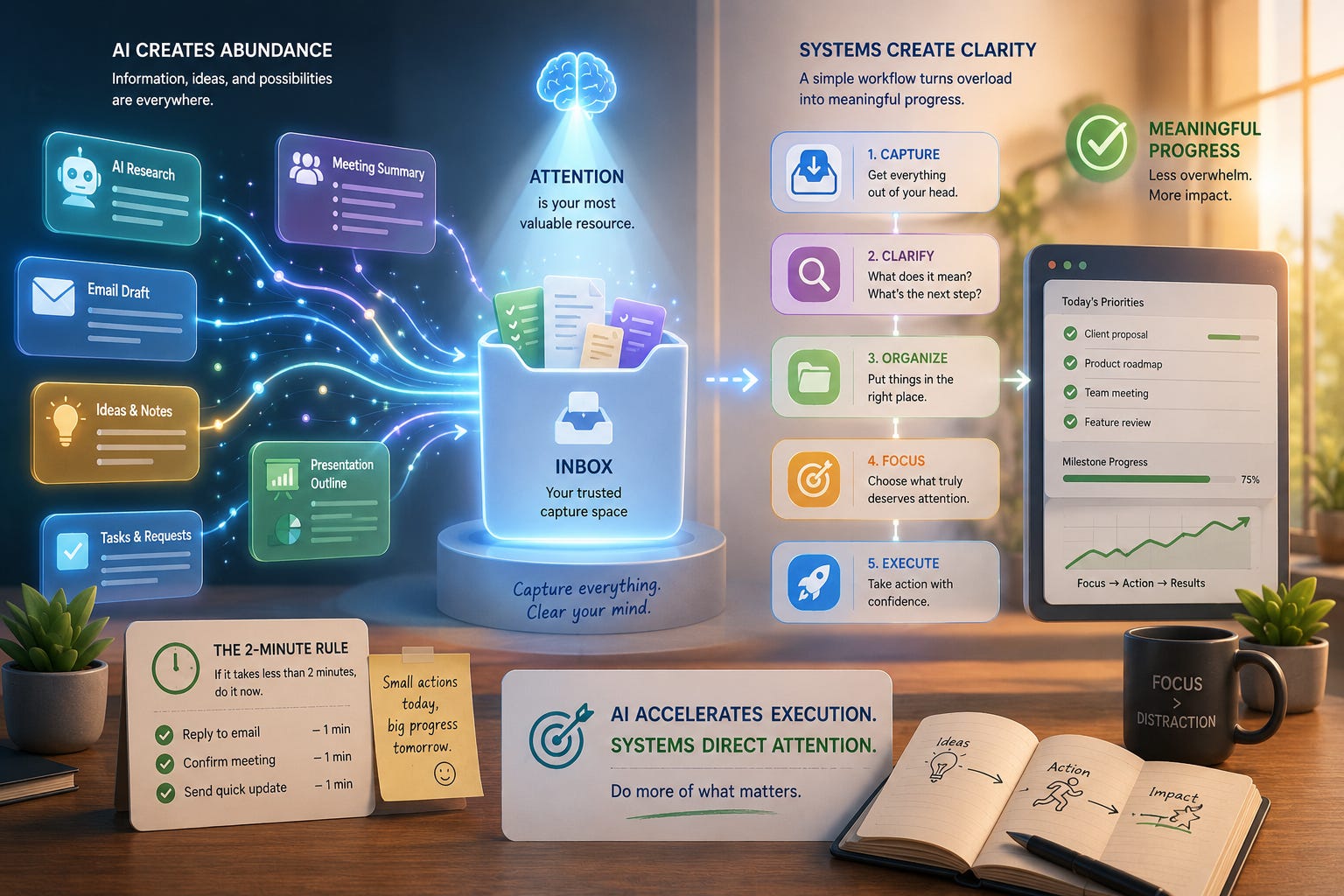
Allen’s solution eventually became one of the most influential productivity systems ever created: Getting Things Done, or GTD. At its core, GTD is built around a simple observation. Your brain is excellent at generating ideas, but terrible at storing them. Every unfinished task occupies mental space, every forgotten commitment creates stress, and every loose end competes for attention.
Which is why GTD encourages people to capture everything into a trusted system. Not because capturing makes you productive, but because it frees your mind to focus on what matters. The goal isn’t to do more work. The goal is to think more clearly.
Why GTD Matters More in the AI Era
This is where GTD becomes surprisingly relevant.
AI and GTD solve completely different problems.
AI helps us execute faster; GTD helps us decide what deserves attention in the first place. AI can draft the report, summarize the meeting, and generate the presentation. But it can’t fully answer a more important question: should this be your priority right now? That’s still a human decision. And in a world where execution is becoming increasingly automated, attention may become our most valuable resource. Which is why a productivity framework created more than 25 years ago still feels remarkably modern today.
How We Applied This Thinking to Pragmr OnTime
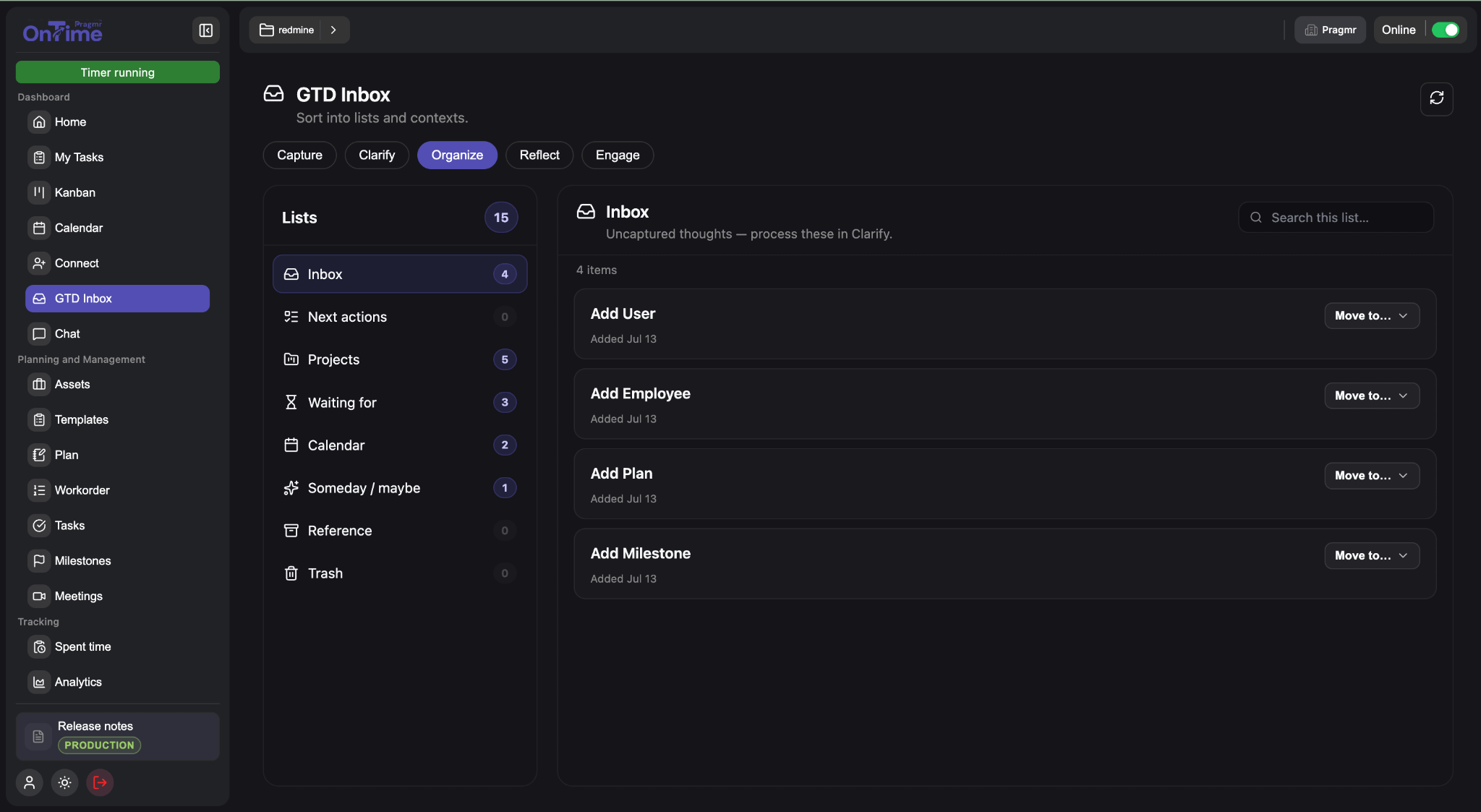
This idea heavily influenced how we designed Pragmr OnTime.
Most platforms help people manage work, very few help people manage attention.
So we built a workflow that mirrors how work naturally happens: Plans become Work Orders, Work Orders break into Tasks, and Milestones track progress. Around this sit meetings, analytics, Kanban boards, team chat, and Connect, our virtual office.
But managing work is only half the equation.
The other half is managing attention
and that’s where Getting Things Done (GTD) influenced our thinking.
One of GTD’s core ideas is that work becomes easier when you have a trusted system to organize it instead of relying on memory. That philosophy shaped how we designed our workflow, ensuring every piece of work has a clear place, from high-level Plans down to Work Orders, Tasks, and Milestones.
The goal is simple. Less clutter and more clarity.
The Bigger Lesson
The AI industry is obsessed with building smarter tools, and that’s exciting. But productivity has never been purely a technology problem , it’s a systems problem. The most productive teams aren’t necessarily the ones with the most AI subscriptions; they’re the ones with the clearest workflows, the ones that know what deserves attention, the ones that can move from idea to action without drowning in complexity.
That’s why a 25-year-old productivity framework still matters in 2026. Because sometimes the answer to AI overload isn’t another AI tool. It’s a simpler system. And perhaps that’s what Minimalism in AI is really about.
See You in the Next Commit.